
A Melbourne office manager once signed what looked like a straightforward cleaning contract. Three months later, she was arguing with the cleaning company about whether “general cleaning” included emptying the kitchen bins. The cleaner insisted it didn’t. The contract said nothing specific. She paid an extra $200 per month to resolve it.
This happens more often than it should. You assume certain tasks are included. The cleaner assumes they’re extras. The contract uses vague language that supports both interpretations. By the time you realise the problem, you’re locked in.
This article covers seven specific contract elements that prevent these disputes. It’s a practical checklist, not legal theory. If you’re about to sign a cleaning contract or reviewing an existing one, use this to identify what’s missing before it costs you money and time. For broader context on selecting the right provider, our 2026 Commercial Cleaning Services Sydney guide covers the full evaluation process.
Why cleaning contracts go wrong (and cost you more than money)

The real cost of a bad cleaning contract isn’t just the disputed invoice. It’s the staff member who complains about dirty bathrooms three days running. It’s the hour you spend on the phone trying to get the cleaner to come back and fix something. It’s the hygiene issue that a client notices before you do.
Most problems don’t stem from bad service. They stem from assumptions made before signing. You thought “deep clean” was included quarterly. The cleaner thought it was an annual extra at $800. Poorly drafted contracts with vague terms lead to disputes because each party interprets the same words differently.
A Sydney retail business discovered this when their cleaner refused to vacuum the stockroom. The contract said “customer-facing areas only.” The business owner assumed that meant everywhere customers might go, including the back room visible through an open door. The cleaner disagreed. The dispute took six weeks to resolve and cost more in management time than the actual cleaning.
These aren’t edge cases. They’re the predictable result of contracts that prioritise brevity over clarity.
Scope of work: what ‘general cleaning’ actually means
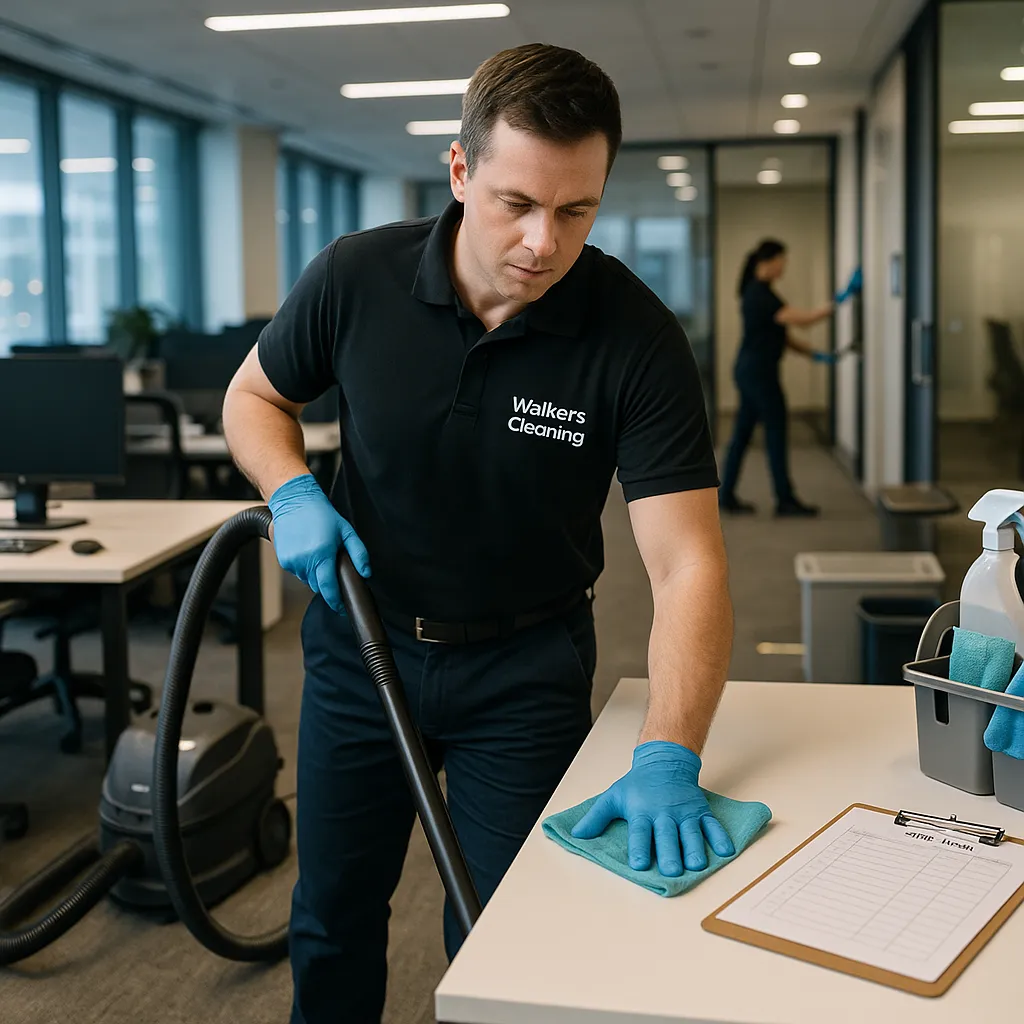
“General cleaning” is the most disputed term in commercial cleaning contracts. It sounds clear. It isn’t.
To you, it might mean everything needed to keep the office presentable. To the cleaner, it might mean floors and bins only. A vague scope of work often leads to disputes because it implies different obligations to each party. What you assume is included may not match what the cleaner assumes.
The solution is specificity across three areas: tasks, frequency, and quality standards.
What tasks are included (and what costs extra)
Your contract should list every task explicitly. Standard tasks typically include vacuuming carpets, mopping hard floors, cleaning bathrooms (toilets, sinks, mirrors), emptying rubbish bins, and wiping down kitchen surfaces.
Common extras that cost more: window cleaning (interior and exterior), carpet shampooing or steam cleaning, high-level dusting above two metres, exterior areas like courtyards or car parks, and specialised floor treatments like polishing or stripping.
Ask for a task-by-task breakdown in writing before signing. If the cleaner says “we do everything,” push back. Define “everything.” A good cleaning company won’t resist this. They want clarity as much as you do.
Don’t assume you know industry norms. What’s standard in one contract might be premium in another. Spell it out.
Frequency and timing commitments
“Three times per week” needs to specify exact days and times. Monday, Wednesday, Friday from 6pm to 8pm is clear. “Three times per week at our discretion” is not.
Address flexibility upfront. Can you change cleaning days with 48 hours’ notice, or are you locked into the original schedule? What happens when a public holiday falls on a scheduled cleaning day? Do you get a make-up day, or do you lose that clean entirely?
Your contract should specify arrival and completion times. If the cleaner arrives at 5pm and your staff leave at 5:30pm, that’s a security issue. If they’re supposed to finish by 8pm but regularly stay until 9pm, that affects your building access and alarm systems.
These details feel minor until they’re not.
Quality standards and inspection rights
Quality standards should be measurable, not subjective. “Professional standard” means nothing. “Visible dust removed from all horizontal surfaces” is measurable.
Your contract should specify your right to inspect work and the process for reporting issues. Can you walk through with the cleaner once a month? Do you submit issues via email or a portal? What’s the response time?
Address how quickly the cleaner must fix problems or redo work. Same day? Next scheduled clean? Within 24 hours?
Ask: “What happens if cleaning doesn’t meet the agreed standard three times in a row?” If the contract doesn’t answer this, you have no recourse beyond termination. That’s not enough. You need a graduated response that includes re-training, supervision, or a temporary price reduction.
Payment terms that protect you from surprise charges

Photo by RDNE Stock project on Pexels
Unclear payment terms complicate collections and strain business relationships. This section isn’t about negotiating lower prices. It’s about predictability and transparency so you can budget accurately and avoid disputes over what you actually owe.
Fixed price vs variable pricing models
Fixed price means you pay the same amount each period regardless of minor variations in work. If the cleaner spends an extra 15 minutes one week, you don’t pay more.
Variable pricing charges based on actual time, supplies used, or square metres cleaned. You pay for what’s delivered, but your invoice fluctuates.
Fixed pricing makes sense for stable environments like offices where the workload doesn’t change much. Variable pricing suits retail or hospitality where foot traffic and cleaning needs vary seasonally.
Watch for hybrid models where you pay a fixed base price but “extras” can quickly inflate the total. If your $500 per week contract regularly comes in at $700 because of extras, you don’t have a fixed price contract. You have a variable contract with a misleading label.
Invoice timing and payment deadlines
Specify whether invoices come weekly, fortnightly, or monthly and when payment is due. Net 7 days? Net 14? Net 30?
Address whether you pay in advance or in arrears. Advance payment means you pay before the work is done. Arrears means you pay after. Advance payment benefits the cleaner’s cash flow. Arrears benefits yours.
Check late payment penalties. Are they reasonable? A 2% monthly penalty (roughly 27% annually) is steep but common. A 10% flat penalty is excessive.
Align cleaning invoices with your accounts payable cycle. If you process invoices on the 15th and 30th of each month, ask for invoices dated to arrive a few days before those dates. It reduces administrative friction.
Price increase clauses and caps
Most contracts allow annual price increases. The method matters.
CPI-linked increases tie price rises to the Consumer Price Index. If CPI is 3.2%, your price goes up 3.2%. It’s predictable and defensible.
Discretionary increases let the cleaner raise prices at will, subject to notice requirements. This gives them flexibility but gives you uncertainty.
Fixed percentage caps limit increases to a specific amount, like 5% per year regardless of CPI. This protects you if inflation spikes but may not be sustainable for the cleaner long-term.
Check notice requirements. How much warning must you receive before a price rise? 30 days is tight. 60 days is reasonable. 90 days gives you time to budget or shop around.
Avoid contracts with no cap or vague language like “reasonable increases.” Reasonable to whom? Define it.
Exit clauses: how to end the contract without penalties
You need an exit strategy when service quality drops or your needs change. Weak termination language is a common contract mistake that traps businesses in arrangements that no longer work.
Exit terms should be clear for both parties, not just favour the cleaning company. If they can leave with 30 days’ notice but you need 90, that’s not balanced.
Notice periods for both parties
Typical notice periods are 30, 60, or 90 days. For cleaning contracts, 30 days is reasonable for short-term arrangements. 60 days is standard for ongoing contracts. 90 days is common for contracts over $50,000 annually.
Notice must be in writing. Email usually counts, but check if the contract requires registered post or a specific delivery method.
Check whether notice periods are mutual. If the cleaner can leave with 30 days’ notice but you need 60, you’re at a disadvantage. Push for symmetry.
Watch for contracts requiring notice only at specific times, like 90 days before the annual anniversary. This means if you miss the window, you’re locked in for another year. It’s a trap.
Termination for cause vs convenience
Termination for cause means ending immediately due to serious breach: repeated no-shows, theft, safety violations, or consistent poor quality that isn’t fixed after written warnings.
Termination for convenience means ending without fault. You just want to change providers or bring cleaning in-house.
Your contract should specify both and the requirements for each. For cause termination usually requires written notice detailing the breach and may allow immediate termination. For convenience termination requires the standard notice period.
Examples of what typically qualifies as “cause”: three consecutive missed cleans without notice, theft or damage to property, safety violations like leaving doors unlocked, or consistent failure to meet quality standards after two written warnings.
Outstanding payment obligations at termination
Termination language should specify what you pay when the contract ends. The fair answer: you pay only for completed work up to the termination date.
Some contracts include cancellation fees. A reasonable cancellation fee might cover the cleaner’s cost to demobilise (returning keys, final inspection). An unreasonable fee is a penalty designed to discourage termination.
If you’ve paid in advance, clarify what happens to unused payments. You should receive a pro-rata refund for any period after termination.
Avoid contracts requiring payment for the full remaining term as a penalty. If you’re two months into a 12-month contract and want to terminate, you shouldn’t owe 10 months of fees. That’s not a termination clause. It’s a lock-in.
Liability and insurance: who pays when something breaks

Imagine your cleaner knocks over a $15,000 server while vacuuming. Or a staff member slips on a wet floor the cleaner just mopped and breaks their wrist. Who pays?
Underestimating liability risks can threaten business and personal assets. Proper insurance requirements and damage processes protect both parties. This isn’t optional fine print. It’s non-negotiable protection.
Public liability and workers compensation requirements
Your cleaner must carry public liability insurance, typically $10 million to $20 million coverage minimum. This covers damage to your property and injuries to third parties caused by the cleaner’s work.
Workers compensation is separate. The cleaner must cover their own staff. If a cleaner is injured on your premises, their employer’s workers compensation should cover it, not yours. But if the cleaner lacks proper insurance, you may be liable.
Request certificates of currency before work begins and annually thereafter. A certificate of currency proves the insurance is active and covers the required amount. Don’t accept verbal assurances.
If the cleaner can’t provide current certificates, don’t sign. The risk is too high. For more on managing ongoing service quality and compliance, see our guide on how to Track Cleaning Performance Commerical Cleaning Sydney.
Damage claims process and liability caps
Your contract should outline the damage claims process: how to report damage, timeframes for submitting claims, and what evidence you need (photos, repair quotes, police reports for theft).
Many contracts include liability caps limiting the cleaner’s liability to the contract value or a specific amount like $5,000. This is common and often reasonable for small contracts.
But consider your risk exposure. If the cleaner damages a $50,000 piece of equipment and the liability cap is $5,000, you’re $45,000 short. For high-value environments, negotiate a higher cap or require higher insurance coverage.
Limitation of liability clauses are standard in commercial contracts, but they should be proportionate to the risk. If your office contains expensive equipment or sensitive materials, the standard cap may not be enough.
Your three-step contract review before signing
Before you sign, take these three steps:
First, read the contract with the seven checklist items in hand: scope of work, payment terms, exit clauses, liability and insurance, plus the specific subsections under each. Tick off what’s clear. Flag what’s vague or missing.
Second, ask the cleaner to clarify any vague terms in writing. Don’t accept verbal explanations. If they say “general cleaning includes X,” ask them to add it to the contract or send written confirmation. Proactive contract review can identify one-sided provisions and unclear obligations before signing.
Third, have a lawyer review the contract if it’s long-term (12 months or more) or high-value (over $20,000 annually). A lawyer costs $500 to $1,000 for a contract review. That’s cheap compared to the cost of a six-month dispute.
Spending an hour reviewing now prevents months of disputes later. Most cleaning companies will clarify terms if you ask. It shows you’re a serious client who understands contracts. That’s a good thing.
If a cleaner refuses to clarify vague terms or gets defensive about reasonable questions, that tells you something about how they’ll handle disputes later. Walk away.
For more information on selecting and working with commercial cleaning providers, visit our homepage for additional resources and guidance.