
You open the email from your facilities contractor. The quote for replacing your office carpet reads $78,000. You stare at the number, wondering if there was a better way to handle this five years ago when the carpet was still salvageable.
Most facility managers face this moment eventually. The question isn’t whether carpet wears out. It does. The question is whether you’re spending $75,000 because replacement was genuinely necessary, or because maintenance never got the funding it needed.
Here’s what the numbers actually show: proper maintenance over five years typically costs 60-70% less than full replacement. That’s not a small difference. For a mid-sized office, we’re talking about $40,000-50,000 that could fund other facility improvements.
But maintenance isn’t always the answer. Sometimes replacement is the right call. This article shows you exactly where the money goes in both scenarios and when each option makes sense for your facility. For more guidance on office cleaning services or maintaining commercial spaces effectively, visit our homepage.
The Sticker Shock: What Full Carpet Replacement Actually Costs in 2026
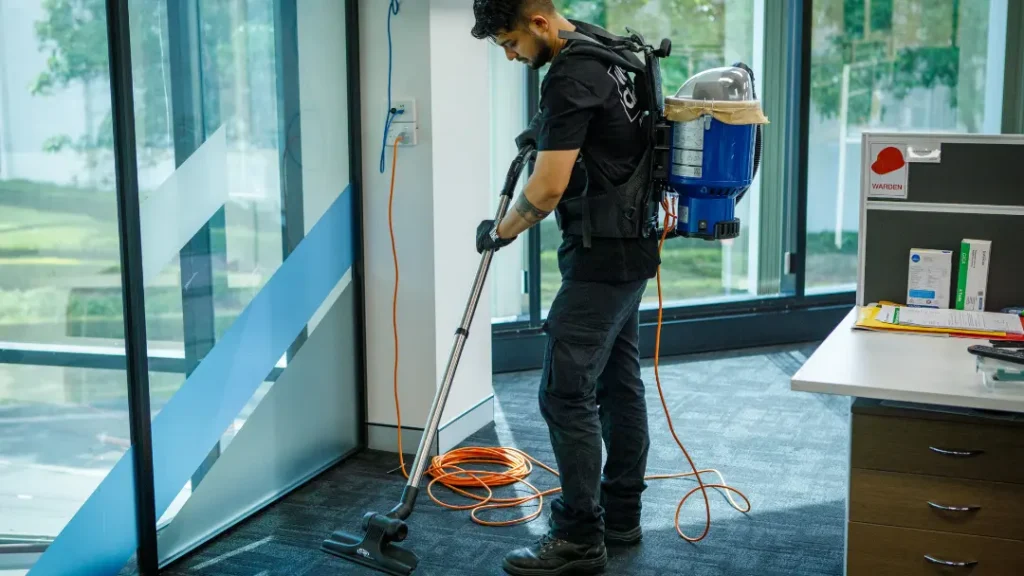
Have you priced carpet replacement lately?
Most people underestimate the total by 40-50%. They see the per-square-metre rate and multiply it by their floor area. That’s the starting point, not the finish line.
Let’s use a consistent example: a 500 square metre office space. Mid-range commercial carpet. Nothing fancy, but not builder-grade either. The kind of spec most businesses actually choose.
Material and installation costs per square metre
Commercial carpet pricing in 2026 breaks down into three tiers. Budget options run $50-80 per square metre including installation. Mid-range specifications sit at $80-120 per square metre. Premium products with extended warranties cost $120-180 per square metre.
What drives these differences? Fibre type matters. Nylon lasts longer than polyester. Density affects durability. A carpet with 5,000 face fibres per square inch wears better than one with 3,000. Warranty length signals manufacturer confidence. A 15-year warranty costs more upfront than a 7-year guarantee, but there’s a reason.
For our 500 square metre office at mid-range spec, you’re looking at $50,000-60,000 for materials and installation alone. That’s before we talk about everything else.
Hidden expenses: disposal, downtime, and furniture relocation
Here’s what most facility managers forget when they’re calculating replacement costs:
Disposal fees run $8-15 per square metre. Old carpet doesn’t vanish. Someone has to remove it, transport it, and pay landfill charges. For 500 square metres, that’s $4,000-7,500.
Furniture moving costs $5,000-12,000 depending on how much you have and how far it needs to go. You can’t install carpet around desks and filing cabinets.
After-hours installation carries a 20-30% premium if you want to avoid disrupting business operations. Many organisations pay this surcharge because the alternative is worse.
These extras add $15,000-25,000 to a 500 square metre project. Your $55,000 estimate becomes $70,000-85,000 pretty quickly.
There’s also the environmental cost. Embodied carbon makes up approximately 50% of the total Global Warming Potential in industrial asset scenarios. New carpet manufacturing represents significant environmental impact, though that doesn’t show up on your invoice.
One more thing: replacement is capitalised expenditure. It affects your budget planning differently than maintenance, which gets expensed immediately. Some organisations find this distinction matters when they’re managing cash flow.
The 5-Year Maintenance Alternative: What Proactive Care Costs

What if you spent that money differently over five years instead?
Maintenance only works when it’s consistent and properly funded. Sporadic cleaning doesn’t count. You can’t skip three quarters, deep clean once, and call it a maintenance program.
For the same 500 square metre office, total five-year maintenance typically runs $25,000-35,000. That’s everything: professional cleaning, preventive measures, and minor repairs.
Annual professional cleaning and spot treatment budget
The recommended schedule: quarterly deep cleaning at $2,000-3,000 per visit, plus monthly spot treatment at $400-600.
Annual cost works out to $10,000-14,000 for 500 square metres. Over five years, that’s $50,000-70,000 if you’re doing it properly. Wait, that’s more than replacement, isn’t it?
No. Because properly maintained carpet lasts 10-15 years, not five. We’re comparing five years of maintenance to one replacement cycle. The carpet you maintain for five years still has useful life remaining. The carpet you replace at year five is gone.
This expenditure gets expensed immediately rather than capitalised, which some organisations prefer for budget flexibility. For comprehensive cleaning strategies, see our guide on Track Cleaning Performance Commerical Cleaning Sydney.
Preventive measures: entrance matting and high-traffic protection
Upfront preventive investments include entrance matting systems at $3,000-6,000, chair mats for workstations at $1,500-3,000, and carpet protector treatments at $800-1,200 annually.
These measures extend carpet life by 30-50% by preventing 80% of dirt at entry points. That’s not marketing speak. Dirt is abrasive. It cuts carpet fibres. Stop it at the door and you reduce wear dramatically.
Total five-year preventive cost: $8,000-15,000 for the example office.
This connects to basic asset lifecycle principles. Preventive measures reduce consumption rate, extending useful life. You’re not just cleaning carpet. You’re slowing down how fast it wears out.
Minor repairs and patch work over five years
Realistic repair needs for a typical office: 2-3 patch jobs per year in high-traffic areas at $400-800 each, plus seam repairs at $300-600 annually.
Five-year repair budget: $5,000-10,000 for normal wear.
Timely repairs prevent small problems becoming replacement-level damage. A worn patch near the lift becomes a trip hazard if you ignore it. Fix it early and it costs $600. Wait until someone trips and you’re replacing the whole section.
Repair costs should be expensed unless they enhance the asset beyond original condition, according to government accounting guidelines.
The Real Cost Gap: A 5-Year Comparison for a 500sqm Office
Replacement now: $65,000-85,000. Maintenance over five years: $25,000-40,000.
The $40,000-50,000 difference represents real budget savings. That’s not theoretical. It’s money you can spend on other facility improvements or return to operations.
Maintenance requires discipline and consistent funding. Replacement is a one-time decision. Some facility managers prefer the simplicity of replacement. Pay once, problem solved for another 7-10 years.
Fair enough. But only if the carpet genuinely needs replacing.
Year-by-year breakdown: maintenance vs replacement timeline
| Year | Maintenance Cost | Cumulative Maintenance | Replacement Cost |
|---|---|---|---|
| 1 | $5,000-8,000 | $5,000-8,000 | $75,000 |
| 2 | $5,000-8,000 | $10,000-16,000 | $0 |
| 3 | $5,000-8,000 | $15,000-24,000 | $0 |
| 4 | $5,000-8,000 | $20,000-32,000 | $0 |
| 5 | $5,000-8,000 | $25,000-40,000 | $0 |
Maintenance provides continuous value. Replacement front-loads all costs. By year five, you’ve spent $25,000-40,000 on maintenance and your carpet still has useful life. Or you’ve spent $75,000 on replacement and you’re starting the countdown to the next replacement cycle.
When the numbers flip: the break-even point for neglected carpets
If your carpet is already 8-10 years old with visible wear, replacement often makes more sense than intensive restoration.
Trying to save severely degraded carpet can cost 70-80% of replacement without achieving acceptable results. Once useful life is consumed, repair becomes economically inefficient.
Clear signs it’s too late for maintenance: permanent staining that professional cleaning can’t remove, backing deterioration where the carpet feels spongy or separates from the backing, widespread seam failure, or odour that persists after deep cleaning.
At that point, you’re not choosing between maintenance and replacement. You’re choosing between replacement now or replacement in six months after you’ve wasted money on restoration attempts.
Why Maintenance Fails (And Replacement Becomes Inevitable)
Maintenance only works if you actually do it consistently.
Most maintenance failures are funding failures, not strategy failures. The approach is sound. The execution falls apart because budgets get cut or schedules slip.
The consistency problem: irregular cleaning schedules
The common pattern: quarterly cleaning becomes twice-yearly. Then annual. Then “when it looks bad.”
Irregular maintenance accelerates wear exponentially. Missing two cleanings doesn’t create twice the damage. It creates four to five times the damage because dirt compounds. Each day’s dirt grinds yesterday’s dirt deeper into the fibres.
You pay maintenance costs without getting maintenance benefits. You’re spending money on cleaning that’s no longer preventive. It’s remedial. And remedial cleaning costs more while achieving less.
This connects to asset management principles: consumption rate increases when preventive measures are inconsistent. You can’t maintain an asset on an irregular schedule and expect regular results.
Budget cuts that backfire: deferred maintenance consequences
Cutting an $8,000 annual maintenance budget leads to a $75,000 replacement need 2-3 years earlier than necessary.
Organisations often cut operating expenses to protect capital expenditure budgets. Then they face larger capital requirements later because the assets they were maintaining now need replacing.
Deferred maintenance compounds. Each skipped cleaning makes the next one less effective. The dirt that should have been removed quarterly is now embedded. Professional cleaning can’t fully extract it. The carpet looks cleaner after the service, but it’s not restored to its previous condition.
From a facility manager’s perspective: short-term budget wins create long-term budget crises. You save $8,000 this year. You spend an extra $25,000 in three years because you replaced carpet that could have lasted another five years with proper care. For current service options, explore our 2026 Commercial Cleaning Services Sydney offerings.
Making the Call: Your Carpet’s Financial Tipping Point
Simple decision framework:
If your carpet is less than five years old with good maintenance history, maintain it. If it’s eight years or older with poor maintenance, replace it. If it’s five to eight years old, assess condition carefully.
Specific assessment criteria: pull back furniture to check hidden areas for wear patterns, inspect seams and edges for separation, test for odour after cleaning, check backing integrity by lifting a corner if possible.
The $40,000-50,000 savings only materialises with consistent maintenance funding. If you’re not prepared to fund maintenance properly, replacement might actually be the more honest choice.
Calculate your current annual maintenance spend. Compare it to the recommended $10,000-14,000 for 500 square metres. If you’re spending less than 60% of that amount, you’re on the replacement track whether you intended to be or not.